
Killing the Person in the Mirror
Updated: Jul 31
Reflections on the anxiety of our Age in The Substance (2024, Coralie Fargeat)
There is a scene in The Substance where the younger version of the self (the implausibly named ‘Sue’) repeatedly smashes the face of the older version of the self (Elisabeth) into a bathroom mirror – until her face is reduced to a bloody, pulpy mess, and her body drops to the hard, white tiled floor – seemingly dead.
What is known is that Elisabeth and Sue are the same person – they are both, in fact, Elisabeth. And that the brutality inflicted by Sue onto her other self is, therefore, being inflicted onto her own self. As the ominous voice on the phone reminds Elisabeth/Sue on more than one occasion – You Are One.
For me, this dichotomy is the most interesting and intriguing motif (out of many) that feature in this most startling of films. The most obvious (and therefore least interesting) being our current (and mounting) obsession with youth, beauty and aspiring perfection (chiefly of women, but increasingly so of men and boys also). Our admiration and glorification of the façade above all else (in an era of Instagram filters, Photoshopped-imagery, fake news, and distrust of ‘so called’ experts, where ‘optics’ are more valued than truth). The fleeting and transitory nature of popularity and adoration, exemplified most beautifully through the opening 60 seconds of the film, as the Hollywood Star of Elisabeth Sparkle is first laid down, celebrated, visited, admired, photographed and then, as her star fades, stepped on, mocked and ignored, until, in a final humiliation, besmeared and stained by a dropped sloppy joe burger of a clumsy passer by.
All these themes are poked, prodded and explored throughout the movie, but for me, the real core, the heart of the film is the relationship between Elisabeth and ‘Sue’ – which is to say, the relationship that Elisabeth has with her self.
The pretence begins relatedly enough with Elisabeth, on her 50th birthday, desperately seeking to relinquish her fading youth and beauty (the irony is not lost that Demi Moore is a full decade older than the character she portrays). Praised and ‘loved’ purely for her beautiful outer shell, Elisabeth is a hollow being. With no friends, no family, no apparent hobbies or interests, barely a voice (her trademark gesture being a blown kiss to camera) – she is, in fact, not a person at all. In this, we can understand Elisabeth as the personification (quite literally, the em-body-ment) of Hollywood – her only value derived through the outer shell, the outside space of the being, with zero interest in the interior. Indeed, Elisabeth puts me in mind of 2023’s Barbie – a beautiful, empty, vapid thing. A piece of plastic. She has very little dialogue, barely anything to say. She is an object to be talked at, to be looked at, she is the focus of the male gaze. She is a purely passive being.
In her desperation to maintain her only value, and without interrogation, Elisabeth stumbles upon The Substance – an unregulated, unquestioned quick fix solution to her woes. With echoes of poisonous lip fillers, botched Botox injections, and cheapo, lumpy BBLs, Elisabeth grasps onto this solution with barely a second thought. All other concerns to her beauty are secondary. She will risk (and indeed, lose) her life to this.
Elisabeth believes that she is doing this to be kind to herself – by retaining her youth, she gets to keep her fame, her popularity, her beautiful home – all the external signals that define her. She has no internal definitions at all to rely upon – again, empty.
What she believes is an act of self love rapidly and predictably descends into a most extreme form of self destruction, with the arrival of ‘Sue’.
Fargeat utilises the creation of Sue as a device to showcase how much harm and hatred we can express towards ourselves. It is not coincidental that mirrors feature so heavily as a recurring motif through the movie – as Elisabeth/Sue is constantly forced to face (literally) what she has done, and continues to do, to her self. Like human skin, a mirror is a façade, a thin, fragile layer through which we experience ourselves. As a beautiful (yet extremely fragile) woman, Elisabeth is at once drawn to the beauty of her own reflection, and yet, is increasingly horrified at who she sees staring back at her.
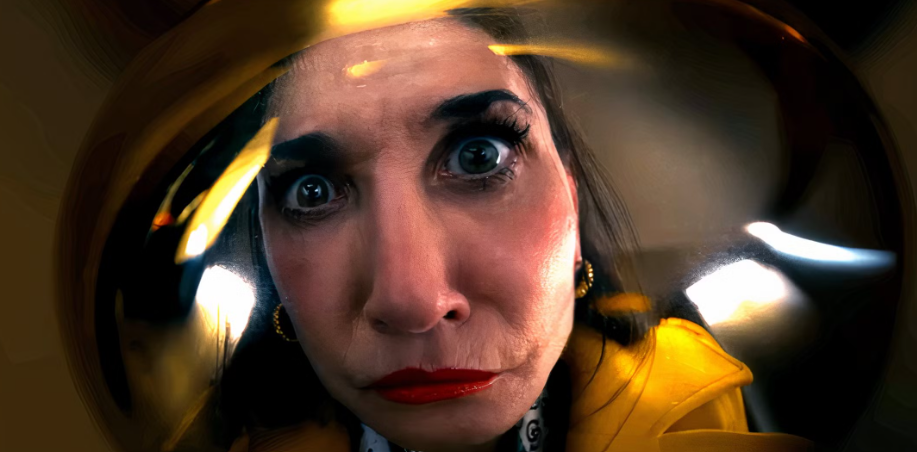
With strict instructions that each 7 days she must switch bodies, a dangerous pattern of (quite literal) self destructive behaviour begins to develop between her two selves.
For Elisabeth, this takes the expression through isolation, binge-eating. For Sue, it’s experienced through the temporary thrills of casual sex, external-validation, rage, and the physical abuse of her older self.
As we swing back and forth between the two selves, this abuse of the self begins to manifest outwardly in Elisabeth’s body – mirroring the increasing damage she is doing to her inner being. There is simply no alternative for Elisabeth, she has nothing else but her body.


Comments